What is Fresh-Dried material?
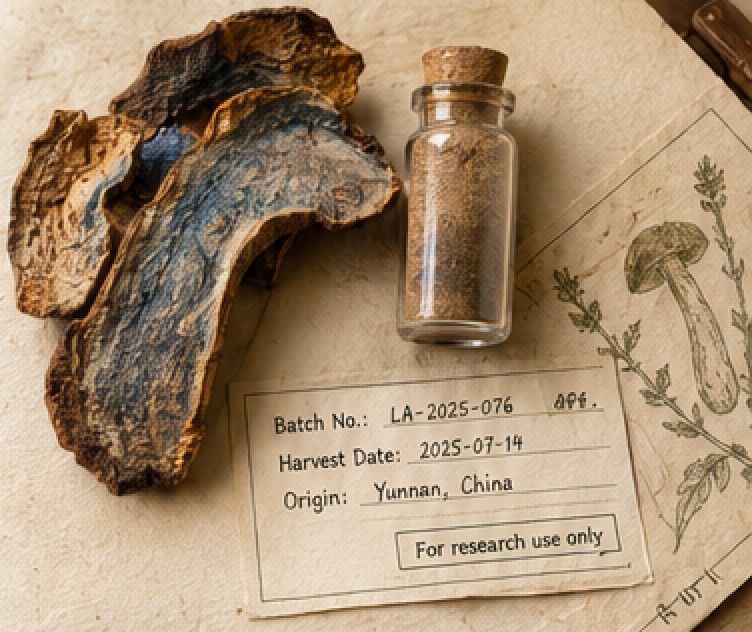
Fresh-Dried is Lanmaoa asiatica sliced lengthwise 5–7 mm thick and dried at 45 °C within 12 hours of picking, until moisture by loss on drying is below 8%. Slices keep the outline of cap and stipe, so the material can still be checked by eye and under a microscope.
| Form | Longitudinal slices, cap and stipe |
|---|---|
| Drying | 45 °C forced air, started within 12 h of picking |
| Moisture | Below 8% (loss on drying, 105 °C) |
| Packaging | Light-blocking barrier bag with silica gel, 1 kg per bag |
| Shelf life | 12 months or more sealed, cool and dark |
| Documents | Batch certificate of analysis |
| Availability | All year, from the most recent harvest |
| Minimum order | 0.5 kg, in 0.5 kg steps |
Why dry at 45 °C?
45 °C removes water fast enough to stop mould and enzymatic browning in thick bolete flesh, while staying well below the temperatures used for cooking. Higher temperatures dry faster but darken the tissue and drive off more volatile compounds. Lower temperatures leave the centre of thick slices wet for too long.
If your research concerns compounds that may be heat-sensitive, keep in mind that we have no species-specific data on how drying at 45 °C affects them. Published poisoning reports cluster around undercooked mushrooms, which some authors read as a sign of heat sensitivity. For that kind of work, fresh tissue frozen at −80 °C is the more conservative choice.
What is dried material suited for?
Solvent extraction, chemical profiling, elemental analysis, reference and teaching collections, and microscopy of rehydrated tissue. Dried slices store for a year or more, so one batch can supply a whole series of experiments. For replicate extractions that need a homogeneous starting material, the milled research powder is usually the better fit.
How do I rehydrate slices for microscopy?
Soak a small fragment in water or 3% KOH for a few minutes until it softens, then section with a razor blade. KOH also clears the tissue for observing hyphae and basidia. Spores can be scraped from the dried pore surface and mounted directly in water, KOH or Melzer’s reagent.